
-

World Maritime Day 2026-27 Theme- From Policy to Practice: Powering Maritime Excellence
Read moreAn analysis of the IMO’s 2026–2027 theme, From Policy to Practice: Powering Maritime Excellence, examining what it signals for governance, compliance, and institutional readiness in the Caribbean maritime sector.
-
IoT, Smart Sensors and Cold‑Chain Monitoring
Read moreThis article examines why sensors and monitoring tools alone do not prevent spoilage, and why effective cold‑chain performance depends on clear governance, coordination, and decision‑making across ports, logistics networks, and regulatory authorities.
-

Climate-Risk Disclosure for Maritime and Coastal Assets
Read moreClimate‑risk disclosure is becoming strategically unavoidable for Caribbean ports. This article explains how TCFD, ISSB and emerging UK/EU standards shape expectations and outlines a proportionate, region‑appropriate pathway for credible climate‑risk reporting, supported by recent Caribbean initiatives.
-

Food Security in the Caribbean: Addressing Post Harvest Loss Through Cold Chain Management
Read moreThis article examines food security in the Caribbean, focusing on post-harvest loss, cold-chain management, and supply-chain constraints shaping food availability.
-
Digital Transformation in Ports & Logistics
Read moreDigital transformation in ports and logistics is improving efficiency, visibility, and resilience across Caribbean supply chains. Learn how digital port systems, smart sensors, and cold‑chain monitoring are strengthening maritime trade.
-
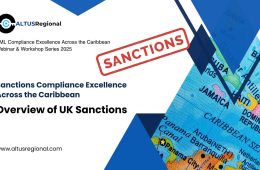
Overview of UK Sanctions
Read moreThe foundation of the UK sanctions regime is the Sanctions and Anti-Money Laundering Act 2018 (SAMLA). SAMLA grants powers to the UK Government, particularly the Secretary of State for Foreign, Commonwealth and Development Affairs (FCDO) and the HM Treasury, to make regulations imposing: trade sanctions, financial sanctions, immigration restrictions and transport and shipping controls.
-

The Money Laundering Cycle
Read moreMoney laundering undermines financial systems by disguising illicit proceeds as legitimate income. This article explores the three-stage money laundering cycle, namely: placement, layering, and integration.
-

Rethinking Financial Crime Supervision in the Algorithmic Age
Read moreAt the recent Altus Regional Panel Discussion on Implementing a Risk Based Approach, speakers explored the rise of AI-driven deception and how criminals exploit the same digital tools designed to promote financial system integrity. From deepfakes and synthetic identities to automated laundering through fintech rails, the threat has become faster, more scalable, and more difficult to detect.
-
Implementing A Risk-Based Approach: The AML Compliance Training Plan
Read moreEffective AML Compliance Training equips Financial Institutions, DNFBPs, VASPs and TCSPs with risk-based frameworks aligned to the FATF Recommendations, and strengthens their ability to deter, detect and report illicit finance.
Consulting theme is an invaluable partner. Our teams have collaborated to support the growing field of practitioners using collective impact.